en English
ar Arabiczh-CN Chinese (Simplified)en Englishfr Frenchde Germanja Japanesept Portugueseru Russianes Spanish
Skip to content
  • Skip to primary navigation
  • Skip to main content
  • Skip to footer

North Sound ACH

North Sound Accountable Community of Health

  • Home
  • About Us
  • Our Work
    • Collaborative Action Network
    • Community Hub
  • News & Press
  • Events
  • Connect

Announcements

We’re hiring!

July 5, 2022 by North Sound ACH staff Leave a Comment

North Sound ACH is currently seeking a Funding Development Coordinator: a grant writer and researcher, and someone who excels at relationship building for leveraging local funds and collaborative action.

This position is full-time and remote, with preference for those located in the North Sound.

Read more about the position, and download the application materials, at our employment page.

Filed Under: Announcements, Community Engagement, newsletter, Staffing

Responding to the Inequities in the Opioid Crisis

June 13, 2022 by North Sound ACH staff Leave a Comment

Megan Tripp, Project Manager

In 2022, North Sound ACH partnered with the Department of Health for a pilot project aimed at getting naloxone into the hands of people in the community. The need for community naloxone distribution is greater now than it ever has been before. Over the past 15 years, opioid overdose deaths in the North Sound region have increased by over 126%, with a particularly rapid increase starting in 2020. San Juan, Skagit, and Snohomish counties have each seen an increase of nearly 150% in opioid overdose deaths.

In an attempt to begin to address this crisis, we have supplied 105 kits of nasal naloxone spray (Narcan) to community partners, who in turn have distributed 44 kits to the people they serve. Each kit contains two doses of naloxone, which means we have gotten 88 potentially lifesaving doses of naloxone into our communities! Program participants have also reported training 48 people on overdose response and naloxone administration. Unfortunately, this program was limited by the funding available to DOH, and that funding has been depleted. We are actively seeking alternative sources for these life-saving supplies while we wait to hear from DOH about renewed funding. 

One of the organizations working with North Sound ACH is Health Ministries Network, an interfaith nonprofit which supports health ministry and works with faith community nurses (FCNs) in Whatcom, Skagit, Island, and San Juan counties by promoting preventive health care, health equity and spiritual well-being. Following a recent local health fair where Narcan was offered to community members, Executive Director Sarah Lane, shared with us, 

It was lovely to sit down with folks and have thoughtful conversations about Narcan distribution. As we let folks know that this was available, some felt called to tell us their recovery stories.  Others wanted to tell us that this was a futile effort—and we could hold space for good discussion.And others quietly came inside, learned, took the Narcan and know we are there for them, wherever they find themselves.”  

Sarah Lane

Fentanyl Awareness Day

The U.S. Senate passed a resolution declaring May 10, 2022 the first National Fentanyl Awareness Day in response to the increased impact of fentanyl in the opioid epidemic, and the sharp increase in overdose deaths over the past two years. The CDC estimates that as many as 107,000 people in the U.S. died as a result of drug overdose between November 2020 and November 2021, and an estimated 66% of those deaths are attributed to synthetic opioids like fentanyl.

Source: CDC

What is fentanyl?

Fentanyl is an FDA-approved synthetic opioid used legally for pain management and, according to the CDC, is “50 times stronger than heroin and 100 times stronger than morphine.” Because of its potency, illicit drug manufacturers have used fentanyl to create stronger, more addictive drugs more cheaply. Fentanyl is increasingly being found in counterfeit prescription pills (fake pills falsely marketed as prescription opioids, anti-anxiety medications, ADHD medications, etc.), cocaine, methamphetamine, and heroin, and many people taking these substances are unaware they are also ingesting fentanyl. The presence of fentanyl in other drugs cannot be identified by appearance, smell, or taste; it can only be detected using fentanyl test strips. 

Opioid overdose and equity

The opioid epidemic was put in motion in 1996 with the introduction and FDA approval of OxyContin as a “minimally addictive” pain reliever.1 For many years after that introduction, opioid use disorder and overdoses disproportionately affected white communities due to racialized opioid regulation, marketing, and prescription rates.2 Black, Indigenous, and People of Color (BIPOC) patients were frequently denied opioid prescriptions to manage their pain due to racial bias in the medical community. However, more recent data suggests a shift in who is most affected by opioid use disorder and overdose deaths. A study published in March 2022 showed that while all racial and ethnic groups had an increase in rates of overdose deaths in 2020, the increase was greatest in Black and brown communities.3 The mortality rate was highest in American Indian/Alaska Native populations, and the largest increase in the mortality rate was in the Black community. Previous studies have shown a correlation between frequency of opioid use and social determinants of health, including level of education, housing stability, and employment status.4 The inequality already faced by BIPOC communities further underscores the racial justice issues embedded in the opioid epidemic today, and the need to respond equitably.

What can I do?

Feeling overwhelmed or hopeless when faced with these facts is very real, but there are ways you can help. 

  • Educate yourself on who is susceptible to opioid overdose – it is not only a risk for people with opioid use disorder or substance use disorder, but can happen to anyone taking opioid medications or illicit drugs.
  • Fentanyl testing strips can be ordered online and should be used to test any substance that was not obtained at a pharmacy or dispensary.
  • Learn to recognize the signs and symptoms of fentanyl and other opioid overdose:
    • Loss of consciousness
    • Slow or stopped breathing
    • Gray or bluish pallor to the skin in light-skinned individuals; ashy skin in darker-skinned individuals
    • Constricted pupils (looks like a pinpoint)
  • Overdoses caused by fentanyl may strike more suddenly, and require additional doses of naloxone to reverse. 
  • Carry naloxone and know how to use it. Naloxone can be purchased at many pharmacies without a prescription, and the cost may be covered by insurance. 
  • Advocate for additional funding from the state to continue vital naloxone distribution programs and fentanyl testing programs.
Sources
  1. Products – vital statistics rapid release – provisional drug overdose data. Centers for Disease Control and Prevention. https://www.cdc.gov/nchs/nvss/vsrr/drug-overdose-data.htm. Published May 11, 2022. Accessed June 10, 2022.
  2. Hansen H, Netherland J. Is the Prescription Opioid Epidemic a White Problem?. Am J Public Health. 2016;106(12):2127-2129. doi:10.2105/AJPH.2016.303483
  3. Friedman JR, Hansen H. Evaluation of Increases in Drug Overdose Mortality Rates in the US by Race and Ethnicity Before and During the COVID-19 Pandemic. JAMA Psychiatry. 2022;79(4):379–381. doi:10.1001/jamapsychiatry.2022.0004
  4. Albright DL, Johnson K, Laha-Walsh K, McDaniel J, McIntosh S. Social Determinants of Opioid Use among Patients in Rural Primary Care Settings. Soc Work Public Health. 2021;36(6):723-731. doi:10.1080/19371918.2021.1939831

Filed Under: Announcements, Community Engagement, Cultural Competency, Equity

Car safety technicians trained in the North Sound

March 18, 2022 by Megan Stephenson Leave a Comment

Becoming a parent is an exciting and very busy time – there are many things to prepare for in order to keep your environment safe for a new baby. Car seats are an expensive but very necessary item to purchase, and the Region 11 Child Passenger Safety team helps caregivers prepare to carry their children safely in their cars, at no cost to the caregivers. Supported by a variety of funding sources, and often working out of local fire departments, law enforcement agencies, and social service agencies, these nationally-certified technicians meet with individuals and families, as well as groups and agencies like hospitals, to provide education and information on proper car seat safety.

Technician Erica Littlewood and expecting parent Tasha going over installing a car seat. Meg Stephenson / North Sound ACH

Morgan and Tasha are first time parents, and after buying a car seat, did an internet search to find who in the area could help them install and understand how to use the seat properly. For those who have not had to use or install a car seat, it may be surprising to learn how complicated it can be. Fortunately, trained technicians in this program are in each county in the North Sound.

North Sound ACH Project Manager Erica Littlewood is the Washington state Region 11 coordinator for the Child Passenger Safety program, and has been doing this work for 16 years. Region 11 consists of Whatcom, Skagit, Island, and San Juan counties. Snohomish County is its own region, and Region 11 and Snohomish County work closely together. 

Technician Erica Littlewood demonstrates installing a car seat with expectant parents Morgan and Tasha. Meg Stephenson / North Sound ACH

After scheduling an appointment, Erica met Morgan and Tasha at the Geneva Fire Station in Bellingham. During the session, Erica explained how car seats should be properly installed, how to use the car seat’s harness (practicing on a baby doll), and an overview of the laws around the different car seats (when an older child can start using a booster, can sit in the front seat, etc).

“This is why we’re doing this, so we feel more powerful,” Morgan said.

Did you know: technicians recommend taking your baby out of the child safety seat every 1-1.5 hours – even though it may be tempting not to disturb baby if they fall asleep, it is better to take them out of that restrictive seat.

Hospitals will ask parents if they have a car seat installed before the birthing parent is discharged, but may not have a trained technician to go over the seat with parents at that time. Making an appointment ahead of time with a technician in your area is recommended.

Erica held a training for 11 new technicians who will work in Whatcom, Skagit, Island, and San Juan counties, as well as two technicians who will work in Snohomish and Pierce counties, in October 2021. Training the technicians, supplying the class with relevant equipment, and teaching space came from North Sound ACH, South Whatcom Fire Authority, and the Children’s Museum of Skagit County. The class was financially supported by the state Child Passenger Safety program.

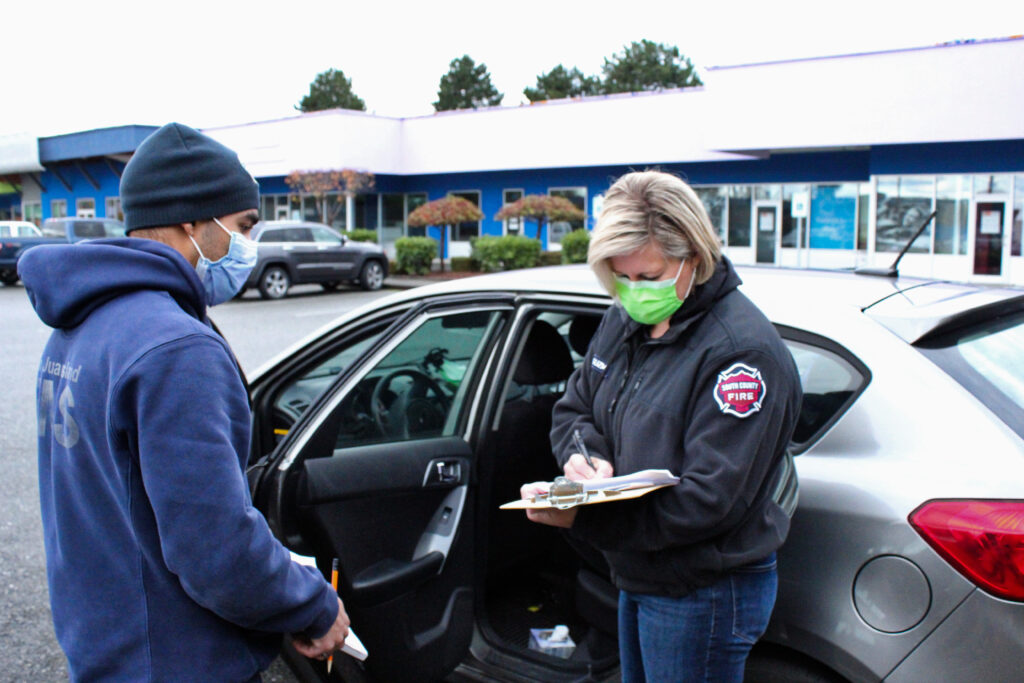
Shawneri Guzman with South (Snohomish) County Fire is a trainer technician, with Trevor Bolton of San Juan Island EMS at the October training. Meg Stephenson / North Sound ACH

Shawneri Guzman works for South (Snohomish) County Fire and has been a child passenger safety technician for 20 years. She didn’t take this type of class when she had her own children, and when she was first trained it was an “eye-opener” for her. Whether the new technicians getting trained were there for their jobs or just as a community volunteer, they do it to help their communities, Shawneri said.

“It’s rewarding to know the family is leaving safer than when they arrived,” she added.

In her 20 years, she’s seen a lot of changes – car seats are more complicated but safer, cars are more complicated, families have changed.

“Culturally, a lot of people come to this country with no experience with car seats, [and] they just want to do what’s right,” Shawneri said.

Trevor Bolton of San Juan Island EMS at the child passenger seat training. Meg Stephenson / North Sound ACH

How can I find a seat or a technician?

The Child Passenger Safety program also has a limited number of car seats for donation to families who are referred by local agencies. For more information, contact Erica at erica@northsoundach.org.

You may search for technicians in your area by going to https://cert.safekids.org/get-car-seat-checked (it will include languages other than English if available).

Where can people donate?

If people want to support the program, they can donate to Safe Kids Northwest:
PO Box 764
Burlington, WA 98233
with “child passenger safety” on the memo line

Funds go to purchase new car seats for the donation program. It’s great if people can share a gently-used car seat with family or friends, but they should not resell a seat or purchase a used seat.

Other resources:

Region 11 Child Passenger Safety Program

National Highway Traffic Safety Administration

Safe Kids Coalition

Filed Under: Announcements, Community Engagement, Equity, Partners

Collaborative Action Network Cohorts – next steps

March 3, 2022 by Megan Stephenson Leave a Comment

Creative tension is common when a group is in liminal space. And it is exactly what is needed for co-creating something new.

During our February learning session, we held space for diverse perspectives to share their hopes, concerns, and questions about the emerging Collaborative Action Network (CAN) Cohorts.

Together, we:

  • Sought clear answers AND recognized we need more time for partner input
  • Experienced discomfort with uncertainty AND excitement for creating something new
  • Acknowledged the need for pragmatism AND the desire for reimagining solutions (and better future for all people and places)

The new cohorts offer a tangible opportunity for partners to create a just and inclusive culture and the necessary conditions for all community members to thrive. The trust and commitment of the North Sound ACH partners is rare – and it will be exciting to see how partners bring this to life over the course of 2022.

FAQs

What do we mean by “cohort” and “focus area”?
A cohort is a grouping of Network selected focus areas that have a strong affinity or common theme. It is also a way for North Sound ACH staff and partners to organize and manage the Focus Areas. We have five cohorts:

  • Equity
  • Vital Conditions
  • Emerging Focus Areas
  • Practice Transformation
  • Care Coordination

Focus areas are the more discrete, actionable areas that Network participants have identified for collaborative learning and action. For example: food security, oral health, or mobile integrated health.

How were these cohorts and focus areas identified?
The North Sound ACH team identified these cohorts and focus areas based on reports from contracted partners, requests and reflections from leaders across the region, and an environmental scan. These topics are driven by our network members and will continue to be shaped by network members.

Can we change our commitments to cohorts or focus areas?
We anticipate that our network will grow and evolve over time. Partners who have signed contracts committing to a particular level of participation in a cohort can amend their contracts if another focus area emerges as an organization priority.

We also hope that additional people will join us over time, sharing their expertise and experiences. Organizations that are not currently engaged with North Sound ACH may join the network and cohorts at any time.

What could the work look like?
Our partner-based workgroups are a forerunner to the Network cohorts, such as the Regional Opioid Collaborative (ROC) and the Oral Health Local Impact Network (LIN). At the February partner learning session, Yuki Yang of Ideal Options shared that the ROC is like a “beta version” of the cohorts.

We come across different funding sources, and we can’t apply for it because we’re for-profit; having this space in these cohorts, to identify these situations, we’re always going to our community partners and saying, there’s this opportunity [for funding], do you want to apply for it and we’ll help support your efforts?
But it’s not always clear what those organizations want or need he money for, so these having cohort discussion to identify what are the solutions we’re searching for, or what are the things we want to try, and then also knowing what funding sources are available, we can say, there’s this opportunity, let’s apply or have a lead organization apply who is a non-profit and we will all deliver on whatever the solution is … that is what we’re talking about: coming together, finding funding, delivering a solution, and being in action.”

Hear more from Yuki at the February meeting recording, starting at 44:59.

What do partners say so far?
Mike Parker of Opportunity Council recognized there is comfort with “prescriptive contracts with defined measurement,” such as the Medicaid Transformation Project. However,

Those things don’t afford a lot of creativity, and so while this may feel unsettling and a little bit new it also can be a spark of creativity. For us, working regionally is one of the great benefits, has been one of the great benefits through [the Medicaid] transformation program. The problems we deal with are so regional or wider than that even, so I just look for more creative opportunities to do out of the box solutions, because obviously what we’ve been doing hasn’t been creating the thriving conditions we want.
So this type of model is maybe exactly what we need to do because it’s different, because it will afford opportunities for us to connect across our different organizations, service territories, you name it, languages… so I’m hopeful.”

Nicole Picknell of South (Snohomish) County Fire said its taken time for her and colleagues in her line of work to get comfortable with creative thinking.

Its super hard for us to be ok with being comfortable with the uncomfortable,” she shared. But working with others, “With the north sound ACH, we did start bringing the community resource paramedics together, and that really started us to find a space that we could feel comfortable in talking about, and there’s value in listening to other people, cause theres things I’ve learned on here that I’m like, oh I had no idea that we actually have a connection.”

Hear more from partners by watching the February learning session on our YouTube page.

We invite you to bring more questions to the team – you can always email us at Team@NorthSoundACH.org – and at the next partner learning session on March 16. There, we will break out the attendees into the cohorts they are participating in, to get started together!

Filed Under: Announcements, Partners

New donation form on the website

November 3, 2021 by Megan Stephenson

North Sound ACH supports learning, advocacy, and collaborative action across the
region. Building on our regional partnerships, the network can respond quickly and efficiently to
address emerging needs in areas where investments in capacity are critically needed.

We have been asked by many across the region now they can support the work. We now have an online donation form – a simple way for anyone to contribute to several regional programs. Contributing to this work impacts the lives of so many across the region.

Donate

We are currently seeking support for these initiatives:

Afghan refugee resettlement support. Several partner community-based organizations are deeply engaged with newly arrived Afghan families who need immediate support as many arrived with only what they wore on the plane. Your contribution will be sent to partners to help with housing, bedding, hygiene kits, and immunization efforts, as examples. Since some of the smaller community organizations don’t have finance and contracting infrastructure, North Sound ACH is acting as a backbone partner to support them as they do such incredibly important people-to-people support activities.  

Community Health Worker (CHW)/Promotoras Fund. CHWs and Promotoras comprise a trusted workforce that provides interpreter services, navigation, transportation, and education in communities who do not intersect with mainstream messaging or traditional ways of accessing resources. They are often unpaid for their services. Working with community-based organizations, North Sound ACH is building a fund to support training, transportation, and equitable payment for the time this workforce spends advancing well-being in often overlooked communities.

Thank you for your support!

Filed Under: Announcements

Afghan Families Coming to Region

October 25, 2021 by Megan Stephenson

Washington State has a long history of welcoming refugees to our communities, and with the recent arrival of Afghan individuals and families, in addition to the COVID-19 pandemic, Refugee & Immigrant Services Northwest (RISNW), based out of Everett Community College, has stepped in to play a key role.

Executive Director Van Kuno has been with RISNW for 30 years, starting as a volunteer after her own refugee resettlement from Vietnam. When she arrived in 1975, after the fall of Saigon at the end of the Vietnam War, she and her family settled in Minnesota, where she earned a degree in biochemistry. They then moved to Snohomish County, where she volunteered at the Refugee Forum of Snohomish County, which would later become RISNW. After a year, she got a paid position with the Forum, and soon after became its executive director.

Kuno said she wanted to partner with North Sound ACH because of our similar philosophies and mission statements. North Sound ACH provides RISNW support in three overlapping areas: the Community Health Worker/Promotores fund, the COVID-19 response fund, and the recently established Afghan refugee resettlement support fund. “Going through the red tape to get funding takes a chunk out of our busy schedule,” Kuno said. North Sound ACH helps with some of that “red tape,” which “allows us to do the job that we’re supposed to do,” Kuno said.

The COVID-19 response provides rapid testing kits, PPE, food and care kits; and the resettlement support fund is used for rent and housing help, bedding, clothes, and household supplies.

Courtesy of Van Kuno / Refugee and Immigrant Services Northwest

Through the CHW/Promotores fund, RISNW has hired a full-time navigator, who helps connect families to resources they need. This has been a great help since many of the Afghan families arrive with only what they can carry. The newly operating welcome center provides mobile dental, COVID-19 vaccines, hot meals, a worship leader from the local mosque, and staff to help families with housing applications, get children signed up for school, and whatever else they need. So far, RISNW has helped resettle 14 Afghan families.  

“When they meet with the navigator, they say what they want to talk about, what they need, then the navigator does research, provides that information back to them, and provides it in a linguistic and culturally appropriate way,” Kuno said.

Kuno said they let the clients direct what they need, but as a refugee herself, she is intimately familiar with the needs and struggles of newly arriving refugees and immigrants. About 10 years after she started working with RISNW, she noticed many Vietnamese and Cambodian refugee women struggling. Early resettlement efforts helped their husbands get jobs, and enrolled their children in school, but sometimes the women would be left behind. They weren’t able to understand letters in English, but many were also not literate in their native language either. They were isolated from their families and even each other.

Today, Kuno provides incoming women with laptops to get connected online –  to chat with family, friends, and local community; use email; learn English; help their children with school – and encourages them to get their driver’s license. A few years ago, she worked with Iraqi families to help the women get their driver’s license, explaining the benefits to both husbands and wives. To the husbands, Kuno would say they then wouldn’t have to leave work to help get the children to appointments, and to the wives, she would explain this would make it easier to go grocery shopping, take the children to school and the doctor’s office, and go see their friends. She employs the same methods with today’s Afghan families.

“If the woman is strong and healthy, the family will be strong and healthy,” Kuno said.

RISNW is open to all refugees, migrants, and immigrants in the area; they often help people from Somalia, Sudan, Congo, Iran, Iraq, Ukraine, Vietnam, Cambodia, Estonia, and Eritrea. There are 10 offices in the area, in Everett, Lynnwood, Monroe, Arlington, Mount Vernon, and Bellingham.

Their services include employment, English as a Second Language (ESL) resources and classes, education and social services, immigration and naturalization, interpretation and translation, and advocacy. Some of their other long-standing partners include the Employment Security Department, DSHS, and WorkSource. Learn more on their website https://risnw.org.

You may also donate to this fund at https://www.aplos.com/aws/give/NorthSoundACH

Filed Under: Announcements

  • « Go to Previous Page
  • Page 1
  • Page 2
  • Page 3
  • Page 4
  • Page 5
  • Interim pages omitted …
  • Page 11
  • Go to Next Page »

Footer

North Sound ACH
PO Box 4256, Bellingham, WA 98227
Phone: (360) 543-8858
E-mail: Team@NorthSoundACH.org

Facebook Instagram LinkedIn YouTube

Sign up to receive updates

Copyright © 2026 North Sound ACH · Proudly created by Beaux · Log in