en English
ar Arabiczh-CN Chinese (Simplified)en Englishfr Frenchde Germanja Japanesept Portugueseru Russianes Spanish
Skip to content
  • Skip to primary navigation
  • Skip to main content
  • Skip to footer

North Sound ACH

North Sound Accountable Community of Health

  • Home
  • About Us
  • Our Work
    • Collaborative Action Network
    • Community Hub
  • News & Press
  • Events
  • Connect

Cultural Competency

Desfibrilador y Primeros Auxilios – Lopez Island features CPR class in Spanish

March 14, 2023 by Megan Stephenson Leave a Comment

In winter 2023, Lopez Island Family Resource Center (LIFRC), United General #304, and La Cima Lopez hosted a Spanish language CPR/AED/First Aid training on Lopez Island.

The Hispanic community on Lopez Island shared with Karina E. Cerda Aguirre, who works with LIFRC, that there was a great need to have this type of knowledge, due to events that had occurred.

“This course was a great success since all the people who took it here on López are very happy and grateful since some of them wanted to have it before, due to their own incidents, family or friends, and having taken it gave them great security and confidence,” Karina shared. “We believe that these courses make all of us and our community stronger!”
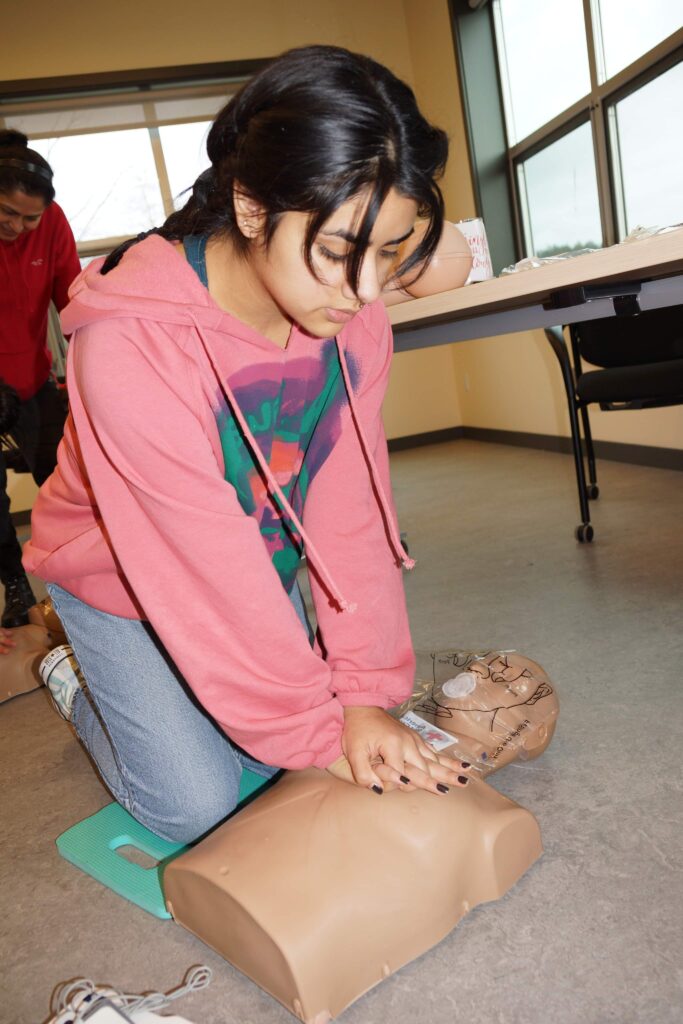
A student practices CPR at the Spanish class at Lopez Island Family Resource Center. Provided by LIFRC.

After obtaining support from the Lopez Island Family Resource Center, organizers wanted to include the La Cima youth leaders since they speak both languages, and because they showed great interest in taking the course and helping people too. Gabe Evenson of United General #304 was the instructor.

Most Hispanic families on Lopez could not take other CPR classes, due to lack of 100% understanding of the English language, but if it were offered in Spanish, they would be happy to participate and learn important skills to keep our community safe and healthy. It also provided confidence and empowerment to Hispanics knowing that they are included in this type of opportunity.

LIFRC hopes to offer another class on Lopez, and involve people from other San Juan Islands.  They hope that someone on Lopez will become a certified CPR trainer in Spanish so more people can be trained.  And that they will have bi-lingual, bi-cultural, Spanish speaking community members work for Lopez EMS someday.


Karina added her thanks to North Sound ACH and our network of partners. “Without your help, we cannot carry out many of our projects with the Latino community of Lopez.”

A student practices CPR at the Spanish class at Lopez Island Family Resource Center. Provided by LIFRC.
Students practicing CPR at the Spanish class at Lopez Island Family Resource Center. Provided by LIFRC.

Filed Under: Partners, Cultural Humility, Cultural Competency, Community Engagement, Announcements

North Sound Accountable of Health invierte en la formación de intérpretes médicos

September 12, 2022 by Natalie Leave a Comment

El año pasado, North Sound Accountable Community of Health (North Sound ACH) desarrolló una encuesta sobre el acceso lingüístico para recopilar datos sobre los idiomas que se hablan en la región de North Sound y comprender mejor cómo apoyar a las organizaciones regionales en proporcionar servicios lingüísticamente y culturalmente apropiados en los servicios sociales y de salud.

Los datos recopilados en la encuesta destacaron oportunidades para aumentar los servicios en idiomas distintos al inglés. En la primavera de 2022, North Sound ACH inició un proyecto piloto para brindar oportunidades de capacitación a personas bilingües y multilingües para incrementar el acceso a la interpretación médica, una necesidad identificada de la fuerza laboral en North Sound.

Los participantes en esta encuesta son organizaciones asociadas con North Sound ACH, incluidas organizaciones comunitarias que prestan servicios a comunidades y naciones tribales en los condados de Whatcom, Skagit e Island.

La encuesta mostró que los principales idiomas para solicitar un intérprete son: español (95%), ruso (64%) y vietnamita (24%). La encuesta también informó sobre la gran necesidad de intérpretes para las personas que hablan lenguas indígenas, como el mixteco alto y el mixteco bajo, lo cual es especialmente difícil encontrar intérpretes locales con estos idiomas particulares de manera oportuna.

North Sound ACH ofreció becas para una clase de capacitación en Whatcom Community College en el trimestre de primavera de 2022; 12 estudiantes bilingües y trilingües se inscribieron en el curso de Fundamentos de Interpretacion Medica, provenientes de los condados de Skagit, Island, Snohomish y Whatcom. De los 12 estudiantes, 11 completaron la capacitación y ahora son elegibles para tomar el examen para la certificación nacional en interpretación médica. Los estudiantes que aprueben el examen serán elegibles para ofrecer interpretación médica a hablantes de mixteco, español y coreano.

Hay una diferencia entre un intérprete y un empleado bilingüe.

Rebeca Sixto era una de las alumnas, bilingüe (español e inglés), que al igual que muchos niños inmigrantes y de primera generación, ella ha estado interpretando de manera informal para su familia y miembros de la comunidad durante años, y a menudo se le pedía que ayudara a traducir o interpretar en sus lugares de trabajo. “A veces se siente como, oh Dios mío, tengo todo este trabajo que hacer,” refiriéndose a su experiencia al tener que traducir mientras estaba en el trabajo, pero “lo estoy haciendo para las personas que lo necesitan.” Ella menciono que siempre ha sido el tipo de persona que ayuda a las personas necesitadas. Después de tomar la clase, Rebeca dijo que aprendió que hay reglas a seguir para asegurarse de que está interpretando correctamente, especialmente en un entorno médico. Los estudiantes aprendieron sobre los estándares legales y éticos para la interpretación.

La compañera de estudios Julieta García Suárez dijo que descubrió que los empleadores a menudo quieren personas bilingües, pero no siempre se ofrece una compensación adicional por sus habilidades. “Hay una diferencia entre un intérprete y un empleado bilingüe,” dijo Julieta.

Todos los estudiantes han visto una gran necesidad de intérpretes, y muchos están motivados para tomar el examen estatal para obtener la certificación, no solo para recibir una compensación adecuada por sus habilidades, sino porque se necesitan intérpretes locales, como se demuestra en la encuesta realizada por North Sound ACH. Muchos de los estudiantes compartieron historias de ser jóvenes e interpretar para sus padres en las citas médicas, o ser la persona a quien acudir para ayudar a los pacientes de habla hispana que vienes a las clínicas donde se trabaja, o incluso si la persona necesitaba ayuda con el papeleo escolar de sus hijos. Tener intérpretes locales también genera confianza en los miembros de la comunidad Latine, dijo Sixto.

North Sound ACH actualmente está buscando sitios de pasantías para los recién graduados de su programa de Interpretación Médica. A través de esta pasantía, los estudiantes practicarán sus habilidades de comunicación, traducción e interpretación, se familiarizarán con el entorno de atención médica y ganarán confianza para brindar servicios de excelencia a sus clientes.

Para aquellos que ya trabajan en el campo de la atención médica, tener una certificación mejorará su capacidad para servir a sus comunidades, reducirá las barreras para los servicios de interpretación dentro de sus organizaciones y será reconocido y compense justamente por el trabajo.

Para aquellos sin experiencia en el campo de la atención médica, esta capacitación y certificación podría ser el comienzo de una carrera en la industria de la atención médica, ya que el graduado estará equipado para trabajar en organizaciones que requieren interpretación y traducción médica para sus clientes.

En 2023, North Sound ACH continuará liderando esfuerzos con socios de la comunidad para expandir el programa de certificación e interpretación médica a personas que hablan otros idiomas identificados en la encuesta de acceso lingüístico.

Las organizaciones que estén interesadas en recibir pasantes o aprender más sobre este proyecto pueden contactarnos en team@northsoundach.org.

Rocio Castillo-Foell, Directora de Participación Comunitaria y Promoción de la Salud habla virtualmente a los participantes del programa de intérpretes. Foto por Gabriela Cardona / North Sound ACH
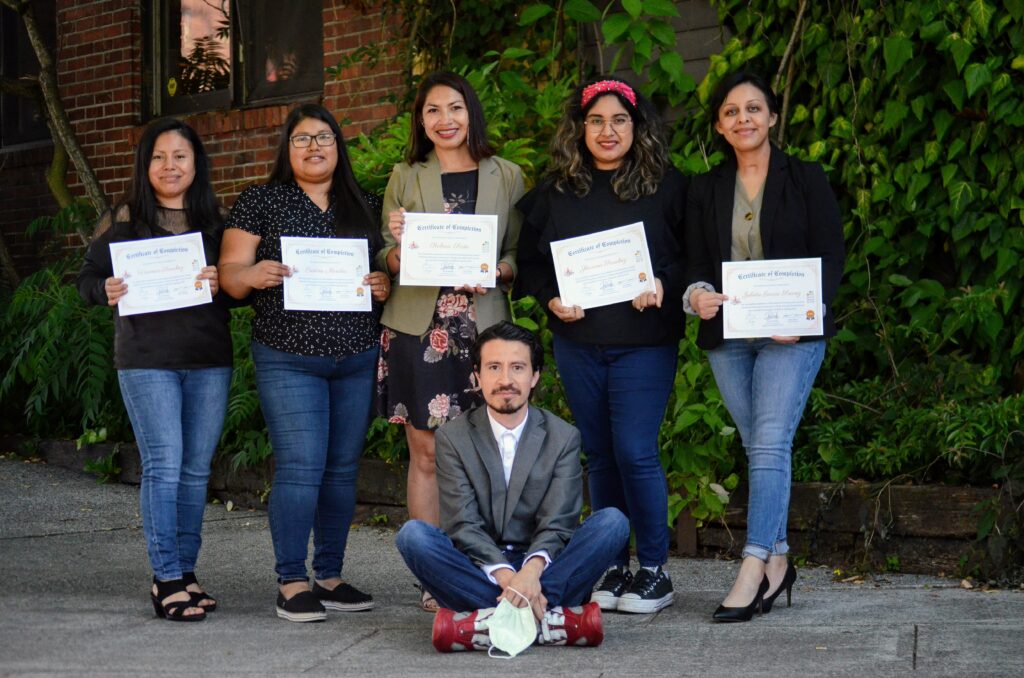
De izquierda a derecha: Veronica Sanchez, Cristina Morales, Rebeca Sixto, Jhovana Sanchez, Julieta Garcia Suarez; Marco Morales. Foto por Gabriela Cardona / North Sound ACH
Jhovana Sanchez y Rebeca Sixto en una cena de celebración en North Sound ACH. Foto por Gabriela Cardona / North Sound ACH

Filed Under: Equity, Cultural Competency, Community Engagement, Announcements

North Sound Accountable Community of Health invests in training medical interpreters

September 12, 2022 by Megan Stephenson Leave a Comment

Last year, North Sound Accountable Community of Health (North Sound ACH) developed a Language Access Survey (LAS) to collect data on languages spoken in the North Sound region, and to better understand how to support partner organizations in providing culturally- and linguistically-appropriate language services in healthcare and social services.

The data collected from the LAS highlighted opportunities to increase non-English language services. In spring 2022, North Sound ACH initiated a pilot project to provide training opportunities to bilingual and multilingual individuals to explore medical interpreting, an identified workforce need in the North Sound. 

The participants in the LAS are North Sound ACH partner organizations, including community grass-roots organizations serving communities and Tribal nations in Whatcom, Skagit, and Island counties. 

The survey showed that the top languages to request an interpreter are: Spanish (95%), Russian (64%), and Vietnamese (24%). The survey also reported the high need for interpreters for Central American Indigenous languages, such as Mixteco Alto and Mixteco Bajo, which is especially challenging to find local interpreters for those languages in a timely manner. 

North Sound ACH offered scholarships for a training class at Whatcom Community College in Spring Quarter 2022; 12 bi- and trilingual students enrolled in Foundations of Medical Interpreting, coming from Skagit, Island, Snohomish, and Whatcom counties, speaking Mixteco, Spanish, and Korean. Of the 12 students, 11 completed the training and are now eligible to take the exam towards certification in medical interpreting. 

There’s a difference between an interpreter and a bilingual employee.”

Rebeca Sixto was one of the students, a bilingual speaker of Spanish and English. Like many immigrant and first-generation children, she has informally been interpreting for her family and community members for years, and was often asked to help translate or interpret at her workplaces. “Sometimes it feels like, oh my gosh I have all this work to do,” she said of being asked to translate while at work, but “I’m doing it for the people that need it.” She said she’s always been the type of person to help people in need. After taking the class, she said she learned there are regulations to follow, to ensure you are interpreting correctly, especially in a medical setting. The students learned about legal and ethical standards for interpreting.

Fellow student Julieta Garcia Suarez said she found that employers often want bilingual speakers, but it didn’t always equate to extra compensation for her skills. “There’s a difference between an interpreter and a bilingual employee,” she said.

The students have all seen a great need for interpreters, and many are motivated to take the state exam to become certified – not just to be appropriately compensated for their skills, but because local interpreters are needed, as demonstrated in the LAS. Many of the students shared stories of being young and interpreting for their parents at medical appointments, or being the “go-to” person for Spanish-speaking patients when working at clinics, even if the person needed help with their children’s school paperwork. Having local interpreters also builds trust in Latinx community members, Sixto said.

North Sound ACH is currently looking for internship sites for the recent graduates of its Medical Interpretation program. Through this internship, the students will practice their communication, translation, and interpretation skills, become familiar with the healthcare environment, and gain confidence to provide excellent services to their clients. 

For those already working in the healthcare field, having a certification will enhance their ability to serve their communities, reduce barriers to interpretation services within their organizations, and be recognized and better remunerated for the work. 

For those with no experience in the healthcare field, this training and certification might be the beginning of a career in the healthcare industry, as the graduate will be equipped to work at organizations that require medical interpretation and translation for their clients. 

In 2023, North Sound ACH will continue to lead efforts with community partners to expand the medical interpretation and certification program to individuals who speak other languages identified in the Language Access Survey. 

Organizations that are interested in hosting interns or learning more about this project can contact us at team@northsoundach.org.

from left to right: Veronica Sanchez, Cristina Morales, Rebeca
Sixto, Jhovana Sanchez, Julieta Garcia Suarez; sitting, Marco Morales. Photo by Gabriela Cardona / North
Sound ACH
Rocio Castillo-Foell, North Sound ACH Director of Community Engagement and Health Promotion, speaks virtually to the interpreter program participants. Photo by Gabriela Cardona / North Sound ACH
From left, Jhovana Sanchez and Rebeca Sixto attend a celebratory dinner with North Sound ACH. Photo by Gabriela Cardona / North Sound ACH

Filed Under: Community Engagement, Equity, Cultural Competency, Announcements

Responding to the Inequities in the Opioid Crisis

June 13, 2022 by North Sound ACH staff Leave a Comment

Megan Tripp, Project Manager

In 2022, North Sound ACH partnered with the Department of Health for a pilot project aimed at getting naloxone into the hands of people in the community. The need for community naloxone distribution is greater now than it ever has been before. Over the past 15 years, opioid overdose deaths in the North Sound region have increased by over 126%, with a particularly rapid increase starting in 2020. San Juan, Skagit, and Snohomish counties have each seen an increase of nearly 150% in opioid overdose deaths.

In an attempt to begin to address this crisis, we have supplied 105 kits of nasal naloxone spray (Narcan) to community partners, who in turn have distributed 44 kits to the people they serve. Each kit contains two doses of naloxone, which means we have gotten 88 potentially lifesaving doses of naloxone into our communities! Program participants have also reported training 48 people on overdose response and naloxone administration. Unfortunately, this program was limited by the funding available to DOH, and that funding has been depleted. We are actively seeking alternative sources for these life-saving supplies while we wait to hear from DOH about renewed funding. 

One of the organizations working with North Sound ACH is Health Ministries Network, an interfaith nonprofit which supports health ministry and works with faith community nurses (FCNs) in Whatcom, Skagit, Island, and San Juan counties by promoting preventive health care, health equity and spiritual well-being. Following a recent local health fair where Narcan was offered to community members, Executive Director Sarah Lane, shared with us, 

It was lovely to sit down with folks and have thoughtful conversations about Narcan distribution. As we let folks know that this was available, some felt called to tell us their recovery stories.  Others wanted to tell us that this was a futile effort—and we could hold space for good discussion.And others quietly came inside, learned, took the Narcan and know we are there for them, wherever they find themselves.”  

Sarah Lane

Fentanyl Awareness Day

The U.S. Senate passed a resolution declaring May 10, 2022 the first National Fentanyl Awareness Day in response to the increased impact of fentanyl in the opioid epidemic, and the sharp increase in overdose deaths over the past two years. The CDC estimates that as many as 107,000 people in the U.S. died as a result of drug overdose between November 2020 and November 2021, and an estimated 66% of those deaths are attributed to synthetic opioids like fentanyl.

Source: CDC

What is fentanyl?

Fentanyl is an FDA-approved synthetic opioid used legally for pain management and, according to the CDC, is “50 times stronger than heroin and 100 times stronger than morphine.” Because of its potency, illicit drug manufacturers have used fentanyl to create stronger, more addictive drugs more cheaply. Fentanyl is increasingly being found in counterfeit prescription pills (fake pills falsely marketed as prescription opioids, anti-anxiety medications, ADHD medications, etc.), cocaine, methamphetamine, and heroin, and many people taking these substances are unaware they are also ingesting fentanyl. The presence of fentanyl in other drugs cannot be identified by appearance, smell, or taste; it can only be detected using fentanyl test strips. 

Opioid overdose and equity

The opioid epidemic was put in motion in 1996 with the introduction and FDA approval of OxyContin as a “minimally addictive” pain reliever.1 For many years after that introduction, opioid use disorder and overdoses disproportionately affected white communities due to racialized opioid regulation, marketing, and prescription rates.2 Black, Indigenous, and People of Color (BIPOC) patients were frequently denied opioid prescriptions to manage their pain due to racial bias in the medical community. However, more recent data suggests a shift in who is most affected by opioid use disorder and overdose deaths. A study published in March 2022 showed that while all racial and ethnic groups had an increase in rates of overdose deaths in 2020, the increase was greatest in Black and brown communities.3 The mortality rate was highest in American Indian/Alaska Native populations, and the largest increase in the mortality rate was in the Black community. Previous studies have shown a correlation between frequency of opioid use and social determinants of health, including level of education, housing stability, and employment status.4 The inequality already faced by BIPOC communities further underscores the racial justice issues embedded in the opioid epidemic today, and the need to respond equitably.

What can I do?

Feeling overwhelmed or hopeless when faced with these facts is very real, but there are ways you can help. 

  • Educate yourself on who is susceptible to opioid overdose – it is not only a risk for people with opioid use disorder or substance use disorder, but can happen to anyone taking opioid medications or illicit drugs.
  • Fentanyl testing strips can be ordered online and should be used to test any substance that was not obtained at a pharmacy or dispensary.
  • Learn to recognize the signs and symptoms of fentanyl and other opioid overdose:
    • Loss of consciousness
    • Slow or stopped breathing
    • Gray or bluish pallor to the skin in light-skinned individuals; ashy skin in darker-skinned individuals
    • Constricted pupils (looks like a pinpoint)
  • Overdoses caused by fentanyl may strike more suddenly, and require additional doses of naloxone to reverse. 
  • Carry naloxone and know how to use it. Naloxone can be purchased at many pharmacies without a prescription, and the cost may be covered by insurance. 
  • Advocate for additional funding from the state to continue vital naloxone distribution programs and fentanyl testing programs.
Sources
  1. Products – vital statistics rapid release – provisional drug overdose data. Centers for Disease Control and Prevention. https://www.cdc.gov/nchs/nvss/vsrr/drug-overdose-data.htm. Published May 11, 2022. Accessed June 10, 2022.
  2. Hansen H, Netherland J. Is the Prescription Opioid Epidemic a White Problem?. Am J Public Health. 2016;106(12):2127-2129. doi:10.2105/AJPH.2016.303483
  3. Friedman JR, Hansen H. Evaluation of Increases in Drug Overdose Mortality Rates in the US by Race and Ethnicity Before and During the COVID-19 Pandemic. JAMA Psychiatry. 2022;79(4):379–381. doi:10.1001/jamapsychiatry.2022.0004
  4. Albright DL, Johnson K, Laha-Walsh K, McDaniel J, McIntosh S. Social Determinants of Opioid Use among Patients in Rural Primary Care Settings. Soc Work Public Health. 2021;36(6):723-731. doi:10.1080/19371918.2021.1939831

Filed Under: Equity, Cultural Competency, Community Engagement, Announcements

Sadness and anger on racial violence – we must speak up

June 3, 2022 by North Sound ACH staff 1 Comment

Shanon R. Hardie, Board Chair

The tragedy in Buffalo still weighs heavy on my mind and heart alongside the shootings in Tulsa, Laguna
Hills, Uvalde and 14 other sites over the Memorial Day weekend. I know it is not new; acts of violence
and racism are inflicted upon our Black friends, neighbors, co-workers, families, and communities every
day and traumatize them further. What is hitting me so hard is that despite so much more focused
attention on racial injustice, there continues to be such regularity of it; the cumulative effect, the
seeming acceptance of it as ‘normal,’ and that in the Buffalo case, it was an 18-year-old that carried out
this evil act. How does an 18-year-old develop such hatred and bias? We accept that we have so much
work to do with older generations raised in an environment with biased and racist cultural norms. But
how, in this day and age, are we still raising children with that hatred? I guess I have been naïve in
thinking that we are raising a new generation that is more aware, more tolerant, more empathetic,
more inclusive. My hope for the future was in the next generation. Expecting they would help us lead
REAL change. I know this is just one young person but if there is one, there are others.

Life is hard and there are so many risks out in the world that can harm and devastate any family. Every
parent worries about their kids. However, I can’t imagine the kind of fear, stress, and anxiety that Black
mothers and fathers have to live with and manage each and every single day. Beyond worrying about
the things all parents worry about – stranger danger, car accidents, being hit by a car, drowning, etc. –
they have to worry that any person their child interacts with will harm them solely because of the color
of their skin. A worry that those of us with white privilege never have to think about. Never having to
ask ourselves…Will they see and appreciate how important my child’s life is? Will they see my child as a
person of value and worthy of kindness and respect? Will they see that my child is as loved and precious
to our family as their own children are to them? Will they see that my child has hopes and dreams just
like their children do? Will they understand and have empathy for my child’s wariness and fear because
of a pattern of inequities, bias, violence, and trauma that they’ve seen happen time and again?

I struggle between heartbreaking sadness and full-on outrage. As a white woman of privilege, I am still
on a learning journey and am committed to increased awareness, adding my voice and taking action. I
am still not always comfortable in sharing my message and voice. I know what I feel in my heart and
what message I want to say but can’t always find the right words to say it. I know many of us of privilege
are in the same boat. However, if we stay silent for fear of saying it “wrong,” then nothing will change.
So, I am working at taking the risk of saying it anyway and knowing that I will get better at it through
humility, owning my missteps and doing better next time. I also know that I will be extended grace for
having my heart and intentions in the right place. I encourage you to join me in taking the risks…. for
that is the only way toward REAL change.

Filed Under: Equity, Cultural Humility, Cultural Competency, Community Engagement

Cultural Humility: A model to learn from

October 1, 2018 by North Sound ACH staff

Evidence based practices and models strive toward better health outcomes and efficiencies, but they don’t always allow for the differences among individuals, cultures and beliefs. We came across a great article on the Robert Wood Johnson Foundation website highlighting an example of how to move from cultural competency to cultural humility and its potential for impact. Check out the article here.

See our October 2018 newsletter at .

Filed Under: Cultural Competency, Equity, Cultural Humility

Footer

North Sound ACH
PO Box 4256, Bellingham, WA 98227
Phone: (360) 543-8858
E-mail: Team@NorthSoundACH.org

Facebook Instagram LinkedIn YouTube

Sign up to receive updates

Copyright © 2026 North Sound ACH · Proudly created by Beaux · Log in