en English
ar Arabiczh-CN Chinese (Simplified)en Englishfr Frenchde Germanja Japanesept Portugueseru Russianes Spanish
Skip to content
  • Skip to primary navigation
  • Skip to main content
  • Skip to footer

North Sound ACH

North Sound Accountable Community of Health

  • Home
  • About Us
  • Our Work
    • Collaborative Action Network
    • Community Hub
  • News & Press
  • Events
  • Connect

Archives for March 2022

Car safety technicians trained in the North Sound

March 18, 2022 by Megan Stephenson Leave a Comment

Becoming a parent is an exciting and very busy time – there are many things to prepare for in order to keep your environment safe for a new baby. Car seats are an expensive but very necessary item to purchase, and the Region 11 Child Passenger Safety team helps caregivers prepare to carry their children safely in their cars, at no cost to the caregivers. Supported by a variety of funding sources, and often working out of local fire departments, law enforcement agencies, and social service agencies, these nationally-certified technicians meet with individuals and families, as well as groups and agencies like hospitals, to provide education and information on proper car seat safety.

Technician Erica Littlewood and expecting parent Tasha going over installing a car seat. Meg Stephenson / North Sound ACH

Morgan and Tasha are first time parents, and after buying a car seat, did an internet search to find who in the area could help them install and understand how to use the seat properly. For those who have not had to use or install a car seat, it may be surprising to learn how complicated it can be. Fortunately, trained technicians in this program are in each county in the North Sound.

North Sound ACH Project Manager Erica Littlewood is the Washington state Region 11 coordinator for the Child Passenger Safety program, and has been doing this work for 16 years. Region 11 consists of Whatcom, Skagit, Island, and San Juan counties. Snohomish County is its own region, and Region 11 and Snohomish County work closely together. 

Technician Erica Littlewood demonstrates installing a car seat with expectant parents Morgan and Tasha. Meg Stephenson / North Sound ACH

After scheduling an appointment, Erica met Morgan and Tasha at the Geneva Fire Station in Bellingham. During the session, Erica explained how car seats should be properly installed, how to use the car seat’s harness (practicing on a baby doll), and an overview of the laws around the different car seats (when an older child can start using a booster, can sit in the front seat, etc).

“This is why we’re doing this, so we feel more powerful,” Morgan said.

Did you know: technicians recommend taking your baby out of the child safety seat every 1-1.5 hours – even though it may be tempting not to disturb baby if they fall asleep, it is better to take them out of that restrictive seat.

Hospitals will ask parents if they have a car seat installed before the birthing parent is discharged, but may not have a trained technician to go over the seat with parents at that time. Making an appointment ahead of time with a technician in your area is recommended.

Erica held a training for 11 new technicians who will work in Whatcom, Skagit, Island, and San Juan counties, as well as two technicians who will work in Snohomish and Pierce counties, in October 2021. Training the technicians, supplying the class with relevant equipment, and teaching space came from North Sound ACH, South Whatcom Fire Authority, and the Children’s Museum of Skagit County. The class was financially supported by the state Child Passenger Safety program.
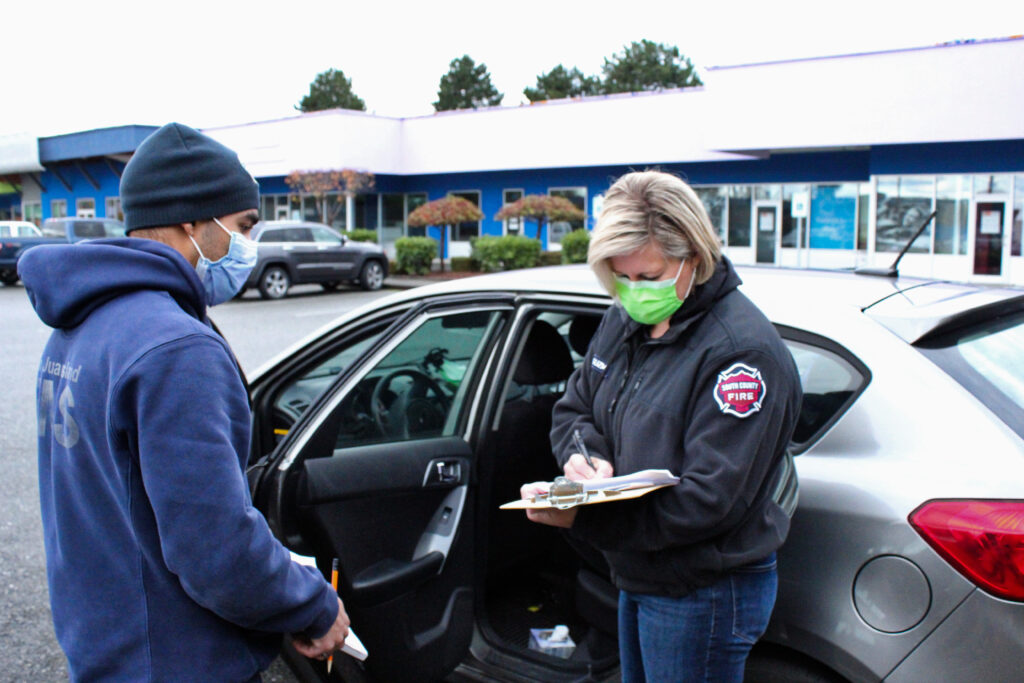
Shawneri Guzman with South (Snohomish) County Fire is a trainer technician, with Trevor Bolton of San Juan Island EMS at the October training. Meg Stephenson / North Sound ACH

Shawneri Guzman works for South (Snohomish) County Fire and has been a child passenger safety technician for 20 years. She didn’t take this type of class when she had her own children, and when she was first trained it was an “eye-opener” for her. Whether the new technicians getting trained were there for their jobs or just as a community volunteer, they do it to help their communities, Shawneri said.

“It’s rewarding to know the family is leaving safer than when they arrived,” she added.

In her 20 years, she’s seen a lot of changes – car seats are more complicated but safer, cars are more complicated, families have changed.

“Culturally, a lot of people come to this country with no experience with car seats, [and] they just want to do what’s right,” Shawneri said.

Trevor Bolton of San Juan Island EMS at the child passenger seat training. Meg Stephenson / North Sound ACH

How can I find a seat or a technician?

The Child Passenger Safety program also has a limited number of car seats for donation to families who are referred by local agencies. For more information, contact Erica at erica@northsoundach.org.

You may search for technicians in your area by going to https://cert.safekids.org/get-car-seat-checked (it will include languages other than English if available).

Where can people donate?

If people want to support the program, they can donate to Safe Kids Northwest:
PO Box 764
Burlington, WA 98233
with “child passenger safety” on the memo line

Funds go to purchase new car seats for the donation program. It’s great if people can share a gently-used car seat with family or friends, but they should not resell a seat or purchase a used seat.

Other resources:

Region 11 Child Passenger Safety Program

National Highway Traffic Safety Administration

Safe Kids Coalition

Filed Under: Announcements, Community Engagement, Equity, Partners

Collaborative Action Network Cohorts – next steps

March 3, 2022 by Megan Stephenson Leave a Comment

Creative tension is common when a group is in liminal space. And it is exactly what is needed for co-creating something new.

During our February learning session, we held space for diverse perspectives to share their hopes, concerns, and questions about the emerging Collaborative Action Network (CAN) Cohorts.

Together, we:

  • Sought clear answers AND recognized we need more time for partner input
  • Experienced discomfort with uncertainty AND excitement for creating something new
  • Acknowledged the need for pragmatism AND the desire for reimagining solutions (and better future for all people and places)

The new cohorts offer a tangible opportunity for partners to create a just and inclusive culture and the necessary conditions for all community members to thrive. The trust and commitment of the North Sound ACH partners is rare – and it will be exciting to see how partners bring this to life over the course of 2022.

FAQs

What do we mean by “cohort” and “focus area”?
A cohort is a grouping of Network selected focus areas that have a strong affinity or common theme. It is also a way for North Sound ACH staff and partners to organize and manage the Focus Areas. We have five cohorts:

  • Equity
  • Vital Conditions
  • Emerging Focus Areas
  • Practice Transformation
  • Care Coordination

Focus areas are the more discrete, actionable areas that Network participants have identified for collaborative learning and action. For example: food security, oral health, or mobile integrated health.

How were these cohorts and focus areas identified?
The North Sound ACH team identified these cohorts and focus areas based on reports from contracted partners, requests and reflections from leaders across the region, and an environmental scan. These topics are driven by our network members and will continue to be shaped by network members.

Can we change our commitments to cohorts or focus areas?
We anticipate that our network will grow and evolve over time. Partners who have signed contracts committing to a particular level of participation in a cohort can amend their contracts if another focus area emerges as an organization priority.

We also hope that additional people will join us over time, sharing their expertise and experiences. Organizations that are not currently engaged with North Sound ACH may join the network and cohorts at any time.

What could the work look like?
Our partner-based workgroups are a forerunner to the Network cohorts, such as the Regional Opioid Collaborative (ROC) and the Oral Health Local Impact Network (LIN). At the February partner learning session, Yuki Yang of Ideal Options shared that the ROC is like a “beta version” of the cohorts.

We come across different funding sources, and we can’t apply for it because we’re for-profit; having this space in these cohorts, to identify these situations, we’re always going to our community partners and saying, there’s this opportunity [for funding], do you want to apply for it and we’ll help support your efforts?
But it’s not always clear what those organizations want or need he money for, so these having cohort discussion to identify what are the solutions we’re searching for, or what are the things we want to try, and then also knowing what funding sources are available, we can say, there’s this opportunity, let’s apply or have a lead organization apply who is a non-profit and we will all deliver on whatever the solution is … that is what we’re talking about: coming together, finding funding, delivering a solution, and being in action.”

Hear more from Yuki at the February meeting recording, starting at 44:59.

What do partners say so far?
Mike Parker of Opportunity Council recognized there is comfort with “prescriptive contracts with defined measurement,” such as the Medicaid Transformation Project. However,

Those things don’t afford a lot of creativity, and so while this may feel unsettling and a little bit new it also can be a spark of creativity. For us, working regionally is one of the great benefits, has been one of the great benefits through [the Medicaid] transformation program. The problems we deal with are so regional or wider than that even, so I just look for more creative opportunities to do out of the box solutions, because obviously what we’ve been doing hasn’t been creating the thriving conditions we want.
So this type of model is maybe exactly what we need to do because it’s different, because it will afford opportunities for us to connect across our different organizations, service territories, you name it, languages… so I’m hopeful.”

Nicole Picknell of South (Snohomish) County Fire said its taken time for her and colleagues in her line of work to get comfortable with creative thinking.

Its super hard for us to be ok with being comfortable with the uncomfortable,” she shared. But working with others, “With the north sound ACH, we did start bringing the community resource paramedics together, and that really started us to find a space that we could feel comfortable in talking about, and there’s value in listening to other people, cause theres things I’ve learned on here that I’m like, oh I had no idea that we actually have a connection.”

Hear more from partners by watching the February learning session on our YouTube page.

We invite you to bring more questions to the team – you can always email us at Team@NorthSoundACH.org – and at the next partner learning session on March 16. There, we will break out the attendees into the cohorts they are participating in, to get started together!

Filed Under: Announcements, Partners

Footer

North Sound ACH
PO Box 4256, Bellingham, WA 98227
Phone: (360) 543-8858
E-mail: Team@NorthSoundACH.org

Facebook Instagram LinkedIn YouTube

Sign up to receive updates

Copyright © 2026 North Sound ACH · Proudly created by Beaux · Log in